That's it, that's the worldbuilding idea.
Tuesday, September 9, 2025

Wednesday, July 2, 2025
Gameable History: Domestic Polytheism
I'm listening to an audiobook of The Ancient City, by Numa Denis Fustel de Coulanges. Part 1 describes indo-greco-roman ancestor worship. It's a kind of domestic polytheism which I don't think I've seen represented in fantasy fiction (except, kind of, Mulan).

To summarize the gameable bits:
- Each family has a god, and their shared god is the defining characteristic of a family.
- If funerary rites are observed, then you join with your god after death.
- If the god is kept satisfied (by feeding the sacred hearth, watering the family tomb with libations, and singing your family's hymns), then they offer protective blessings.
- The primary blessing is warding the land, but the family god can also provide a familiar spirit to protect family members on long journeys, help find good spouses, etc.
- If the god is neglected, their strength will diminish, and your ancestors will suffer and fragment into hungry wandering spirits.
- Gods cannot split or merge, and you can only worship one god.
- You can however switch to a different god via emancipation/adoption, or via marriage (which is a ritualistic form of emancipation from one family and adoption into another).
- The god legally owns the family land. It therefore can't be split or sold to a non-family-member. Primogeniture inheritance is less about land ownership and more about passing on a sacred priesthood.
Extensions
There's enough flexibility in the concept to accommodate magic systems with all sorts of implications. An idea not in the original beliefs but which I think would have fun story implications is if knowledge of the family hymns both grants greater access to and allows you to circumvent the protections of a family's god. True-name style tropes but for an entire clan. That would be a good seed for both inter- and intra- family conflict.
Curious Similarities
The book doesn't touch on this, but I've noticed that this kind of ancestor worship is fairly similar to some aspects of Chinese folk religion. I wonder if the similarities are coincidental, or if they're the result of cultural transmission, as happened with Greece, Italy, and India .
Or I guess another possibility is that neolithic peoples in multiple regions invented similar ancestor worship because ancestral spirits are actually real and all of my ancestors are starving because I've neglected the ancient rites.
my bad if true 🤷
Saturday, October 14, 2023
Wandering Titans, part IV - Hot and Cold, Plus Two More to Complete the Set
This is the final planned entry in a series of Wandering Titans, which are part weather, part giant monster.
Previous parts with more titans: Part 1, Part 2, Part 3
The Plague of Flame
 |
| AI Generated via Bing. "Roman Tile Mosaic of a Rat kaiju towering above a burning city." |
On the horizon (visible in neighboring hexes)
: Smoke rising from burning forests or villages.
Environmental Effect
: Intense heat wave. Metal becomes too hot to touch barehanded. Outbreaks of fever-causing disease. Dry material spontaneously bursts into flame. Swarms of smoldering vermin spontaneously generate where you least expect it.
Appearance
: Flickering apparition of a colossal Rat, wreathed in smoke.
: Flickering apparition of a colossal Rat, wreathed in smoke.
Behavior / Desires
: Hungry. Devours/burns fields, food stores, forests, and wooden buildings.
Things to Discover or Encounter Nearby
- Pyromaniac Rat Cultists. Skin pockmarked and burnt. Constructs of flame or smoke fill their wounds, replace missing limbs, and grant a sort of manic undeath fueled by arson.
- The smoldering vermin sometimes contain valuable exotic chemical substances within their bodies. More common is that they contain nasty exotic diseases.
- Exotic fires and unusual forms of heat, which can be bottled by a skilled arcane technician. Floo, Bale, St. Elmo's, an unnamed species of flame that burns songs as fuel...
- Regular fire, too, if that's what you're into.
The Frigid Scapegoat
 |
| AI Generated via Bing. "Roman Tile Mosaic of a giant sheep or goat creature towering above a frozen city. People pray to it." |
On the horizon (visible in neighboring hexes)
: Snowstorm contained in a precise cylinder.
Environmental Effect
: Cold snap. Flames diminish and new fires cannot be lit. Pipes and vessels of water freeze and burst. Those who freeze to death will find themselves mysteriously revived and healthy when the goat moves on and the landscape thaws, but other harm remains.
Appearance
: Giant Ram with horns like icebergs. Flurries of snow drift out between matted locks of tangled wool.
: Giant Ram with horns like icebergs. Flurries of snow drift out between matted locks of tangled wool.
Behavior / Desires
: It seems to take a fascination in random things, tilting its head and fixing its eyes in place for hours at a time. Sometimes it takes the things, and not just a fascination. It lets out a massive breath, a downburst of bitter frigid air, causing collateral damage and knocking things aside, leaving only the object of the Scapegoat's interest sitting in a wind-blasted patch. This object - which is always perfectly intact whether it be a a statute, a mural, or something abstract - is then delicately picked up with teeth the size of warships and tucked deep into its fur.
Things to Discover or Encounter Nearby
- Ancient treasures tangled in its locks.
- Ancient people too.
- Also something called "slood", which no longer exists anywhere else.
- Petitioners beseech the Scapegoat to take their sins and obligations. If they attract its attention, it is often willing to oblige. It takes one of their limbs, too, frostbitten and broken off by its terrible breath.
- A caravan of frozen corpses. They corpses in question were people dying of something else, and will become so again once they leave the zone of cold. Their caretakers are trying to hitch a ride towards a specialist magical institution which can help them, but the Scapegoat is currently headed in the wrong direction.
- Lots of ice. Quite valuable in some settings.
And here are a couple bits of human-made giant goat artwork I found inspirational: "The Stilted Ram", by Michael MacRae, "Summoning a god", by Calder Moore, and "Giant Goatman and his bridge", by Esteban Hernandez
The Fluffy Floppy Megabunny
 |
| AI Generated via Bing. "Hyper fluffy giant bunny seen from below. Titanic rabbit towering into the sky. Tiny angry beady eyes. Ancient Painting." |
On the horizon (visible in neighboring hexes)
: The horizon and clouds in that direction look faintly blurry, as if seen through some lenses of the wrong prescription. Occasionally, a large white cloud seems to rise and then fall.
Environmental Effect
: Blades and claws are blunted. Stone becomes malleable. Iron becomes as plastic. Minus 1d6 damage when attacking unarmed or with physical weapons. Minus 1d6 from falling or other impacts, as well. A very faint ever-present mist moderates temperatures while making your hair bouncy and voluminous.
Appearance
: Like an opaque cloud that leaps and bounds high into the air before slowly drifting back down.
: Like an opaque cloud that leaps and bounds high into the air before slowly drifting back down.
Behavior / Desires
: Oh how it hates! It yearns in its heart to tear apart the pathetic creations of mortals. To trample their farms, and bring their empires to ruin, to lead mindless armies into pointless slaughter, and to hear their lamentations. Of course, none of that is obvious from its vast vacant expression. It just seems to bounce around harmlessly and at random.
Things to Discover or Encounter Nearby
- When the titan lands on top of you, it's said to be quite a relaxing experience, "like a fog made of hugs". It impairs visibility a bit, but doesn't impair movement and only lasts a few minutes at a time.
- Occasionally, patchs of "fluff" can get caught on brambles. These can be magically spun into a something like silk which is bouyant in air.
- Although the softening aura of the titan impedes the function of some devices, it enables forms of otherwise impossible crafting. A train of artisans follow the Megabunny in mobile workshops, creating ornate and durable artifacts out of materials which are difficult to work anywhere else.
- This train has grown over the years into a Wandering Festival which is part carnival and part trade show. In the big top, trapeze artists perform stunts without a net, jugglers juggle swords by the blade, and big dudes punch each other in the head while laughing.
- Because blades and bludgeons are blunted, the most effective means of dealing with ne'er-do-wells (besides hiring a wizard) is via grappling. A tradition of wrestling has developed in the Wandering Festival, and the greatest wrestlers from all over the world come to demonstrate their prowess. Elaborate costumes are not required to enter the tournaments, but are appreciated by the crowds.
- Lots of happy people.
The Wretched Ape
 |
| "monkey" |
On the horizon (visible in neighboring hexes)
: Clouds of dust. Faint tremors and distant echoes of loud noises.
Environmental Effect
: Earthquakes.
Appearance
: Big monkey. (Not actually an ape.)
: Big monkey. (Not actually an ape.)
Behavior / Desires
: It's a big monkey that knocks things over and shakes its fist at clouds. When it jumps around, it causes earthquakes.
Things to Discover or Encounter Nearby
- Things which have been knocked over by a big monkey.
Saturday, July 22, 2023
Worth the Candle: The Exclusionary Principle (Free Worldbuilding PDF)
I've helped put together a pdf for Alexander Wales' worldbuilding document The Exclusionary Principle. It's basically a splatbook for the setting of his webnovel, Worth the Candle, which focuses on the setting's exclusion zone, areas where degenerate magic has been divinely quarantined.
Click here to download a PDF of The Exclusionary Principle
 |
| In the pdf, this map has clickable text which links to different chapters of the worldbuilding document. |
Alexander Wales wrote The Exclusionary Principle.
I helped with the PDF layout, and also created the map you see above.
Other art in the document is AI generated.
(Wales initially planned the thing to just be a small list, but one thing led to another, and sometimes things get a bit out of hand and you end up with a 150 page worldbuilding document.)
Friday, June 16, 2023
Reblog: Worth the Candle: The Exclusionary Principle
This is a reblog/recommendation for a book-length chunk of oddball world-building which you can read here: Worth the Candle: The Exclusionary Principle
Each short "chapter" describes some magical phenomenon that's been divinely quarantined after getting out of hand. 35 chapters have been published so far, and the remaining chapters will be published one-per-day for the next month.

|
| There will also be a pdf once it's all done. |
This is a worldbuilding supplement to Alexander Wales' Worth the Candle series. Quoth the Wale:
The exclusions doc was written with the intent that you didn't absolutely need to have read Worth the Candle, but there might be some mild spoilers, and there are occasional notes from various characters on the exclusions. If you haven't read WtC, just dive in and hopefully there's enough explanation in either the preface or the other worldbuilding doc for you to get by. Or let the words wash over you and any confusion can be a part of it.
These "chapters" (each ~1K words) will be posted to AO3, and linked on my subreddit and on my Discord, where I expect the majority of the discussion to take place.
All text of The Exclusionary Principle has been written by
Alexander Wales. The art is AI-generated. My contributions are the pdf
formatting, some minor edits, and
the map.
(In case you're wondering, The Slug is not actually a canon part of the document. I just made him up to test the pdf templating. But he's still canon in my heart.)
Monday, May 15, 2023
Slug Exclusion Zone
Name: Slug Exclusion Zone
Code: SLEZ
Types:
Minor, Enpersoned?
Date: 237 AM
Summary: The Slug Exclusion Zone (SLEZ) is a circular exclusion zone about a mile in diameter that contains a single giant slug.
History: Slug magic was a form of magic that allowed practitioners to bond with slugs and use them as extensions of their own bodies. Slug mages could dip their hand in a vat of slugs and get a prosthetic slug hand that could manipulate objects, secrete slime, or fire projectiles (made of slugs). Slug magic was also used for healing, as slugs could regenerate wounds by permanently bonding with their host. Slug magic was popular in the region of Slough, where slugs were abundant and revered as sacred animals.
In 237 AM, a group of researchers from the University of Lysia San Slough decided to study the potential of slug magic for healing head injuries. They experimented on volunteers who had suffered brain damage, implanting slugs into their skulls and using slug magic to stimulate neural regeneration. However, something went wrong with the procedure, and instead of healing the volunteers, it transferred their ability to use slug magic to one of the slugs. This slug escaped from the laboratory and began to consume other slugs, growing in size and power. It also developed a rudimentary intelligence and a hostile attitude towards humans.
The slug slowly rampaged through the city of Lysia, leaving a trail of slime and destruction behind it. It killed three people and injured dozens more, before it reached the outskirts of the city and encountered the exclusion barrier.
Features: The SLEZ is dominated by the presence of the giant slug, now estimated to be about eight hundred feet long and several feet thick, with a mottled brown color and numerous eyes and tentacles. It can use slug magic to manipulate other slugs within the zone, and spends much of its time herding a 'flock' of small ordinary slugs throughout the zone, eating whatever sparse vegetation manages to grow there among the slime-encrusted ruins. In addition to its mastery of slug magic, the giant slug also wields a number of looted entads, which are now embedded in its slimy hide. One of these entads grants it the ability to project its thoughts as speech, an ability it most frequently uses to announce its hatred of humanity and to recite crude poetry about moss.
Only a relatively small portion of the city of Lysia was enveloped in the exclusion zone, and much of the rest of the surrounding city remains inhabited. Even the University continues to operate, though in a greatly reduced capacity after the loss of its main campus. A minor, but important, part of the post-exclusion Lysian economy revolves around trade with the giant slug. Despite its professed hatred of humanity, the slug is capable of using its magic to produce vast quantities of slime with various properties, and is willing to do so in exchange for organic refuse. These slimes are useful in various industrial processes and are also used directly in the manufacture of a number of consumer products.
There is rarely a need to send expeditions into the zone - and such expeditions make the slime negotiations more difficult besides - but with proper planning, these can be carried out safely. After the initial evacuation of the city, no one has been since been killed by the giant slug. Although the slug is a fierce combatant at close range, and does try to kill anyone who enters the zone, its top speed is less than one foot per minute.

Sunday, February 19, 2023
Ground Squirrels : Tree Squirrels :: Dwarves : ???
Dwarf digs hole. He also lives in the hole. Some squirrel is like that.
But some squirrel lives in the tree and digs to bury his treasure.
Another important thing about Tree Squirrels is that they forget about a lot of the nuts they bury. Those nuts grow into the trees in a form of forgetful symbiosis.
If a dungeon is the acorn, then what is the tree?
Please, my soul yearns for the answers to these mysteries.
Wednesday, February 15, 2023
Some Quick Hexcrawl Horizon Visibility Calculations
How far away can an object be before it dips below the horizon and is no longer visible?
For simplicity, treat the planet like a smooth perfect sphere, and ignore the atmosphere and any other obstacles.
Table of Examples
Assume that your eyes are 1.8 meters above the surface of an earth-sized sphere. From how far away can you see the tops of various objects?
| Object | Object Height (m) | Visable Distance (m) | Vis. Dist. (miles) |
|---|---|---|---|
| The Ground Itself | 0 | 4,800 | 3.0 |
| Garden Gnome | 0.5 | 7,300 | 4.5 |
| Another Person | 1.8 | 9600 | 6.0 |
| A Male Giraffe | 5.2 | 13,000 | 8.0 |
| An Aspen Tree | 16 | 19,000 | 12 |
| Statue of Liberty (with base) | 93 | 39,000 | 24 |
| Great Pyramid of Giza | 140 | 47,000 | 29 |
| Statue of Unity (with base) | 240 | 60,000 | 37 |
| Burj Khalifa | 830 | 110,000 | 67 |
| Mount Everest | 8800 | 340,000 | 210 |
| Severe Thunderstorm | 18000 | 480,000 | 300 |
Arc distance along the ground is same as straight-line distance, up to the precision I used for these numbers. Once you get up to the Mount Everest row, the difference is on the order of one mile.
The practical takeaways for hexcrawling are that if you're standing in the middle of a flat twelve-mile hex, then:
- You can just barely see the top of someone's head if they're standing at the edge of the hex. (But there's probably a shrubbery in the way.)
- You can see the top of a mature tree standing in the middle of the neighboring hex. (If you use a telescope and there are no other trees in the way.)
- You can see the top of a giant robot from two hexes away. (Very important to know.)
- You can see storms and mountains from quite some distance. (Haze will be more important than horizon by that point. I don't know whether you'd actually be able to recognize a storm at 300 miles (25 hexes), but here are a couple anecdotes of people noticing thunderstorms from more than 120 miles (10 hexes) away under the right conditions.)
I've seen similar numbers before, but wanted to recalculate everything in a tidy little list for my own use.
Calculator widget below
Monday, October 17, 2022
Teeth are Magic Crystals.
We all know wizard teeth are full of magic.
But in fact, all teeth and bones are full of magic to varying degrees. Living animals accumulate magic in their bodies when interacting with the aether. This magic settles in the form of magicite crystals, which integrate neatly into the apatite crystals found in non-magical bones and teeth. Any creature which lives in a magically rich environment will develop a more magicitic skeleton, and grow more resistant to injury as a result.
(This is also why the cheapest form of mana potion is simply concentrated bone broth. Makes a good stew and recharges your fireballs too.)
Bones and Teeths with Special Powers
Some creatures have adapted to direct their bioaccumulation of magicite towards specific parts of their skeletons, and to shape it for more esoteric effects.
In big apex predators like wolves and lions, the magicite concentrates in the fangs. This imbues their bites with supernatural killing power. The most dramatic example of this is the smilodon's ability to bite things from several paces away.
Other examples of tissues with high magicite concentration include the horns of antelopes, the clubs of mantis shrimp, the dermal denticles of certain sharks, and the tusks of the mighty porcine unicorn.
(Larger animals and apex predators tend to accumulate more magicite, but there are exceptions to this rule.)
Magical Bird Pearls
Birds (and frogs and some other creatures) lack teeth or other bony protusions, and tend to have unenhanced skeletons. Instead, they ingest a small rock or particle of sand, and then coat it with layers of magicite. The resulting magicitic gastroliths, or mana pearls, are most commonly used simply to aid in digestion, but can also be channeled to more exotic effects.
Who can forget the fire-breath of the flamingo, the shield-penetrating honk of the celestial goose, and the psychic calls of the songbirds?
You can never quite be sure what a hawk is capable of. They ingest and store the pearls from the birds they eat as prey, and elderly hawks are on par with young wizards in terms of the diversity of their spellcasting abilities.
Teeth are the Catalyst for Verbal Spellcasting
In humans, the magicite concentrates in the teeth, but not as a weapon. Human dental magicite is the reason that song and incantation enhances spellcasting.
A child's milk teeth are essentially mundane, being apatite-based. The second set of developing adult teeth are imbued with magicite throughout the first years of a child's life. And it is only once they erupt that a child begins to display magical aptitude. Wisdom teeth are so called because they develop for longer and so accumulate a higher concentration of magicite.
People often lose their teeth as they age, and it used to be that they needed ivory dentures to maintain their magical abilities. This all changed, of course, with the discovery of arguably the most important spell of the modern wizarding era: Fauchard's Renewal
Wizards Regrow Teeth Like Sharks
Anyone who practices magic frequently, and thus cycles more aether through their body, will accumulate additional magicite. But because their teeth have already erupted and stopped growing, most of this magicite goes towards strengthening the skeleton and generally enhancing the constitution.
Fauchard's Renewal is a spell with stimulates the growth of a new set of adult teeth. It was initially used as a way to improve the quality of life of the elderly. But it was quickly discovered that when grown in the mouth of a spellcaster, this tertiary set of teeth has an incredibly high magicite-to-apatite ratio. It is thus now standard practice to apply this spell to students at the conclusion of their magical training. Practicing wizards have lost both their baby teeth and their adult teeth, and now have "wizard teeth".
Wizard teeth are powerful magical items and valuable ritual components. Some mages are thus tempted to apply the spell multiple times, harvesting teeth to enhance their power. However, this process is stressful on the body. The nutrients that would be directed towards reinforcing the bones and counteracting the effects of aging are instead directed towards growing more teeth. Those who abuse the process risk premature aging.
(Also, if you beat up a wizard and steal their teeth, you can make dentures which give you a wizard level.)
Saturday, October 1, 2022
22 Magical Teas, and the Plants from Which they're Made
The following is a list of 22 strange plants used for brewing magical teas. Each entry describes where this plant can be found or how it can be cultivated. Each accompanying image is AI-generated by Wombo's Dream AI.
This was written for Stick for the Spring 2022 Secret Jackalope blogpost exchange. My apologies for the delay.
1. Bartered TeaTea made from the Il Plagato plant promotes a calm mind and enhances physical dexterity, but only if the leaves are willingly given to the harvester. Stolen leaves are bitter and have a diuretic effect. Such plants are typically willing to part with some leaves in exchange for entertainment, and are known to be especially fond of juggling. |
 |
Monday, November 29, 2021
A Metric System for Faerun
In many tabletop roleplaying games, the round of 6 seconds, and the space or square of 5 feet serve as basic units of measurement for game mechanics. Just for fun, let’s try to actually construct a system of measurements using these as our base units for time and distance.
The self-imposed rules of the exercise are as follows:
- Derived units are expressed simply in terms of base units. (Coherence)
- Larger or smaller units use a consistent exponential power (Though I’m not sticking to decimal).
- And if possible, the resulting system should feel psuedo-medieval, be intuitive to a 21st century American, and be useful for rules of thumb in a tabletop rpg.
Tuesday, August 24, 2021
321 Hero* Dice: A post about unusual dice anatomy.
This post briefly mentions HeroQuest. As such, we must begin by viewing
the sacred liturgy.
Once this is done, you may return for the rest of this blogpost.
Several games use six-sided dice with the following properties:
The structure of the dice:
Several games use six-sided dice with the following properties:
- 3 of the faces share the same symbol, usually indicating a successful 'attack' result.
- 2 of the other faces share a second symbol, usually indicating a successful 'defense' result.
- The final singular face has its own distinct marking.

|
| An example of what these dice look like. Photo credit to Eric on BGG. |
What follows are some examples, and my thoughts about adapting these dice for RPGs.
Tuesday, August 17, 2021
d6x6 City Names, Poorly and Literally Translated
In what follows, I've taken the names of places, translated them into English, and when the namesake itself was a name, I've gone and translated that too.
Don't take this too seriously. I haven't worked too hard to verify the translations or etymologies. In some cases where it sounded interesting, I went with suspect folk etymologies.
Cities in the Fishhook Language Ball:
1. The Most Populous Cities in the Southern Lands:
- Wide Watermeadow
- Mill Stream
- Broken Bone
- Wood
- Noble Sort
- Gold Coast
2. The Most Populous Cities in the United States of Laborious Rule:
- New Pig Farm
- City of The Angels
- Garlic
- Town of the Mind Clan
- Phoenix
- City of Brotherly Love
Friday, August 13, 2021
12 Mile Hexmaps overlayed onto the Contigous United States
Hey, there. I put a 12-mile hex grid onto North America. The projection is Lambert Conformal, so there's minimal distortion, at least within the US.
Rivers, train-lines, and urban areas are included, but there are no labels.
So, if you happen to want an unlabelled 12-mile hex map of North America with rivers, train-lines, and urban areas, then this is the blogpost for you.
 |
| click for slightly lightly bigger version. |
And click here for a very very big version of this map which includes more of Mexico.
More maps below.
Monday, August 2, 2021
d6x6 Elemental Powers: Wood
Inspired by this post by Red_Kangaroo.
All xylomancers are resistant to poison and illness.
1. Wood magic is about strength.
- Wood in your sight can't be bent or broken.
- Augment your strength with vines coiled around your limbs.
- Form self-repairing wooden plate armour around your body.
- Reactively form a protective wooden dome around yourself when attacked.
- Lift and swing massive logs and poles as if they weighed no more than a twig.
- Bring to life mannequins and totems which you carve from wood. They'll follow your commands, but are only capable of brute force, and not fine manipulation.
2. Wood magic is about endurance.
- Your skin is faintly green. Time spent in the sun makes you rapidly heal.
- Become tougher and more immovable the longer your feet are firmly planted on the same piece of ground.
- Tap a contiguous piece of wood to render it immovable and inviolable. The effect lasts until you apply it to a different piece of wood.
- Repair wounds - yours or another's - with wooden prostheses that work as well as flesh.
- Go without food or water or rest, and ignore severe injuries, as long as you remain in contact with living plant matter
- Care for a specific plant. If that plant grows ill, so will you. But as long as that plant flourishes, you cannot be killed.
3. Wood magic is about growth.
- Sing to plants to make them grow at visible speed.
- Snap your fingers to make a sapling instantly, explosively, destructively grow into a full-size tree.
- Dense and diverse vegetation sprouts in your footsteps. You have limited control over the kind of plants that grow.
- Grow to many times your normal height, with strength scaling more than proportionately. The extra mass sloughs of as leaf litter when you sleep.
- Cause dense roots to burst from the ground and ensnare a target, growing around them. Needs existing roots as a starting point.
- Extend and retract your limbs like Inspector Gadget. The extra length can take the form of either vines or hardwood.
4. Wood magic is about weird plant-themed whatsits.
- Emit soporific spores from flowers blooming from your skin.
- Organic material rapids decays under your touch.
- Implant a parasitic sprout into someone's body to parasitically siphon away their lifeforce.
- Absorb light energy into your skin and concentrate it without bound. Re-release all the light at once.
- Rapidly grow parachutes of cottony fibers.
- Exude sticky sap in place of sweat.
5. Wood Magic is about being in tune with nature.
- Step into a tree-trunk, and step out from any trunk connected to the same wood web.
- Meditate in a grove to gain tactile awareness of all the creatures therein.
- Speak to trees. Learn the strange things they've seen and heard.
- Plants and undergrowth don't hinder your passage. They bend out of your way while reaching to trip those who pursue you.
- Trees grow and slowly twist into shapes convenient for you. Chairs, spears, houses, etc.
- In exchange for tender care, Trees will relocate at your command. You need to shout; they're hard of hearing.
6. Wood Magic is about hurting people... with wood.
- Shoot seeds as projectiles from out of your palms.
- Cause impaling thorns to burst from nearby wood.
- Summon and swing whip-like vines.
- Staffs and polearms can grow and shrink in your hands.
- Summon razor-sharp and impossibly rigid leaf blades.
- Stab a stake into something to destroy it utterly.
Here is some visual inspiration: 1, 2.
Bonus: 6 more elemental powers to combine with Kangaroo's lists to make a nice round 200:
- The element of Storm: Call down a lightning bolt directly on your location.
- The element of Glass: Glass shards cannot cut you, and in your hands they can cut through anything.
- The element of Osmium: You can telekinetically move osmium with your mind. It's quite strong, and has impressive range, but only works on highly purified osmium (which happens to be the rarest of the precious metals).
- The element of Friendship: You can fire concussive beams of force from your palms that, in addition to knocking people off their feet and breaking their bones, also overwhelms them with an intense longing for companionship.
- The element of Flesh: Sprout nasty flailing tentacles.
- The element of Surprise: It's a gun. The surprise is that you can somehow own a working firearm in a magical psuedomedieval fantasy world.
Wednesday, July 28, 2021
Micropost: Pantheon of the Eternal Industrial Era.
Vatra - The Primordial Mother Fire. Embodied in the Sun (Her fire above) and Coal (Her fire below). Consumed the previous world and from its ashes were born the gods.
Qiri - The Daughter Fire. Goddess of the Moon, gas, oil, lamps, chemistry, and noxious gasses.
Avull - Goddess of steam, waterfalls, storms, engines, beasts of burden, passion, and blood.
Hekuri - God of iron, foundries, bellows, mining, cement, stone, and the rail.
Turma - Goddess of agriculture, abundance, forestry, crowds, crowding, and plague.
Udhetar - God of canals, calm seas, trade, travel, deserts, desire, and desperation.
Fabrika - Goddess of management, textiles, wisdom, planning, and mass production.
Zare - God of gold, entrepreneurship, investment, prophecy, games and greed.
Shoku - Goddess of community, conformity, communication, the telegraph, lightning, roads, and repair.
Genje - God of paper, printing, knowledge, literacy, eloquence, entertainment, diplomacy and deception.
Martesa - Goddess of boundaries, borders, property, contracts, marriage, and oaths.
Ushtar- God of lead, law, order, rage, war, and gunpowder. Punisher of broken promises.
Kupon - God of the wilds. Merchandising.
Inspired by this prompt from Discord user DefinitelyNotAnEggHahaha:
In many fantasy worlds, the gods create the world in a sort of medieval stasis. Humans, dwarves, etc, have medieval-level tech handed to them from day one, and the gods that exist in these worlds also often reflect that technology level (god of the harvest, god of the forge, etc). That is to say, these gods would make no sense in a world where everyone is a hunter-gatherer.
So, with that established, worldbuilding idea: A world created in a sort of industrial era stasis. Have gods of oil rigs, and railroads, and such
A sort of dirty steampunk kind of vibe, where tech never actually progresses because of the influence of these gods
PS: Kupon is literally just the Greek god Pan in a top hat and ill-fitting three-piece suit.
Friday, July 23, 2021
Astropost: Astronomical Objects, Their Symbols, and Their Namesakes
I want to play a game set in a mythologized version of the Solar System. So I took some notes on the bits and bobs floating about.
 |
| Click to open in a new tab. |
The following is an incomplete list of objects in the Solar System, along with their namesakes and symbols.
Thursday, June 17, 2021
Fragmentary Powers v2.0 - A Tarot Deck Generator for Janky Superpowers
Use this to generate confusing and bizarrely conditional supernatural powers.
This is an expanded version of the previous post, tweaked to be used with a deck of cards.
Potential use cases:- Janky superhero one shots.
- Store brand JoJo stands.
- Clearance-sale magic items.
- Use these powers in place of GLOG templates? Bad idea? Best idea?
To manually generate powers, draw three cards from a tarot deck, and consult the tables below. The first card determines the Triggering condition, the second determines how the power manifests, and the third determines what element the power applies to. If you're using a poker deck, then simply ignore the trump suit and Cavalier cards, and map the red and black jokers to the Fool and the Magician.
Sunday, June 13, 2021
Fragmentary Superpowers - Two experiments with randomly generating jank.
I need some janky superpowers. Here are a couple of little experiments to
randomly generate such things.
The first combines an activation condition with a power and an element:
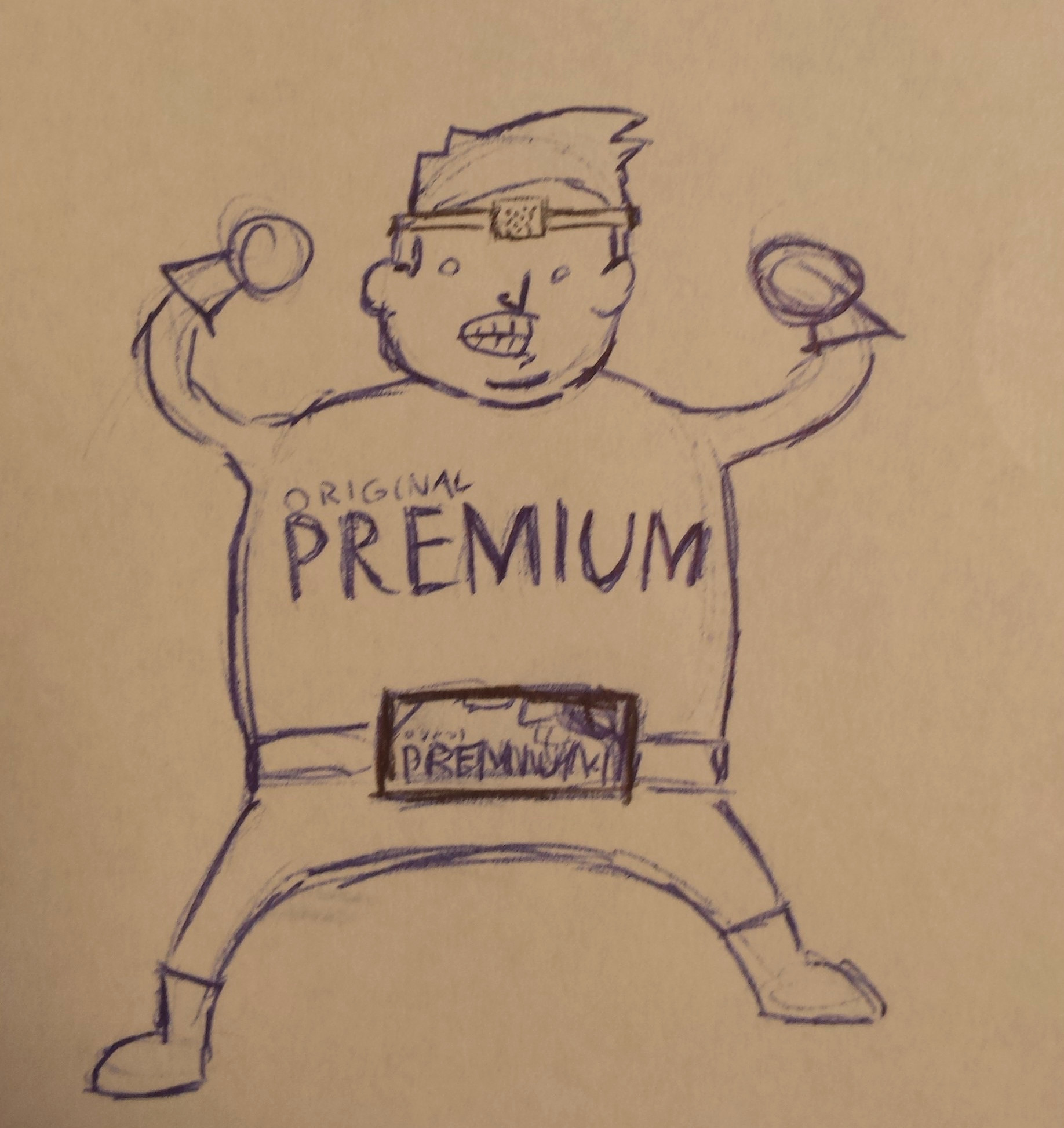
The second just picks a few options from a list of 'partial' superpowers. Fire summoners are immune to fire. Super strongos have the unbreakable bones needed to support their strength. What if those required secondary powers were just doled out at random instead of being properly matched?
Here are a few doodles of janky superheroes for inspiration. The tables used in the above generators are down below.
|
||||
| Original Premium - While chanting, saltine crackers randomly appear nearby |

|
|
Thick Liz - Immune to disease, doesn't need to breathe, can talk to fish
(they don't listen) |

|
|
Capn' Flappy - Changes direction of local gravity, redundant wings |
Sunday, June 6, 2021
Wizards in Rayon Stockings: Some worldbuilding notes on plastics.
How reasonable is it is include plastics in a psuedo-medieval fantasy world
without fossil fuels?
A better title might be "Alchemists in Rayon", because of course you can just
wave your witchofingers and summon tupperware from the realms of chaos. But
even restricting ourselves to low-magic fantasy, for many plastics, it's
totally reasonable to throw them in. They'll probably just be
rarer and considered
high-quality objects instead of throwaway trash.

|
|
Clearly, the question on everyone's mind when they see this
compilation of public domain witches is "Where did they get those sweet leggings?" |
Skip to the end if you just want a bulleted list of which plastics I thinks a witch might be able to brew in a cauldron. But otherwise, come with me on this scatterbrained journey into the world of organic chemistry.
Subscribe to:
Posts (Atom)